
Therapeutic Plasma Exchange & Alzheimer's Research | IFHO
What the AMBAR clinical trial reveals about plasma exchange, cognitive function, and the future of precision medicine.
Alzheimer’s disease remains one of the most challenging conditions in modern medicine. Despite decades of research, understanding the biological processes driving cognitive decline continues to be a major scientific priority.
But a growing area of investigation is expanding the conversation beyond the brain itself.
What if modifying the composition of circulating blood plasma could influence biological processes associated with neurodegeneration?
This question has brought therapeutic plasma exchange (TPE) into an emerging field of neurological research.
One of the most compelling investigations, the Alzheimer’s Management by Albumin Replacement (AMBAR) trial, reported encouraging findings in cognitive and functional outcomes among patients receiving a structured plasma exchange treatment regimen.
The findings are particularly interesting because they suggest that the systemic circulation may represent another avenue for investigating neurodegenerative disease.
At the Institute for Human Optimization (IFHO), we follow developments like these closely. They reflect an important principle of precision medicine: understanding the interconnected biological systems that influence health, disease progression, and physiological function.
What Is Therapeutic Plasma Exchange?
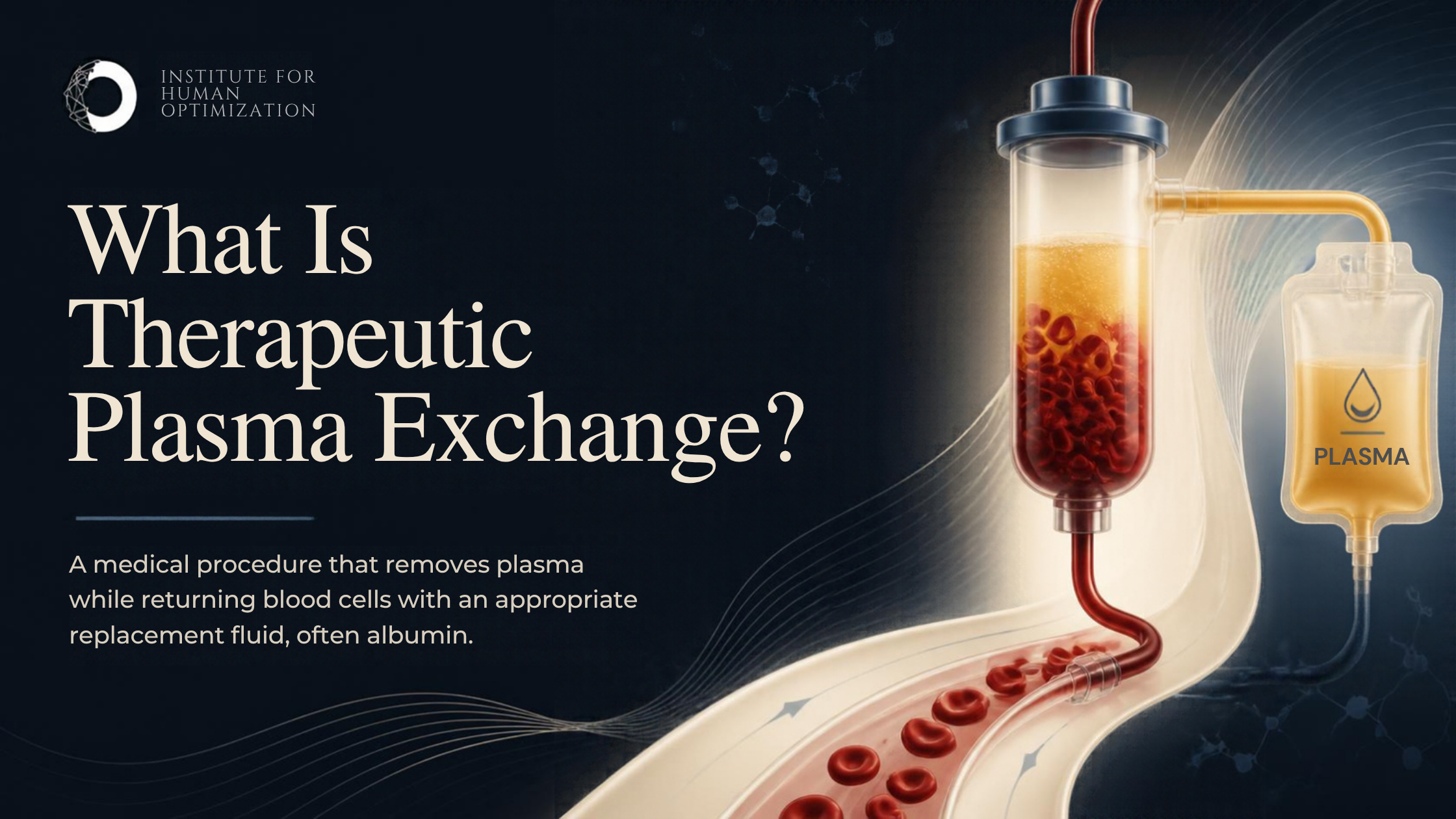
Therapeutic plasma exchange is a medical procedure that separates and removes plasma from circulating blood while returning blood cells to the patient with an appropriate replacement fluid, often albumin.
Plasma contains thousands of biologically active substances, including circulating proteins, antibodies, inflammatory mediators, and metabolic byproducts.
By exchanging plasma, clinicians can substantially alter the concentration of certain circulating substances.
TPE has long been used for established medical indications involving immune-mediated, hematologic, and neurological conditions.
Its potential applications in Alzheimer’s disease and biological aging are now areas of scientific investigation.
The emerging interest is not simply in what plasma exchange removes, but in how changing the circulating environment might influence biological function.
The AMBAR Trial: Encouraging Results in Alzheimer’s Disease
Published in Alzheimer’s & Dementia in 2020, the AMBAR study investigated plasma exchange with albumin replacement in patients with mild-to-moderate Alzheimer’s disease.
The randomized, controlled phase 2b/3 trial enrolled 347 participants across research centers in the United States and Spain.
Participants in the active treatment groups underwent six weeks of conventional plasma exchange followed by approximately 12 months of lower-volume plasma exchange. Treatment groups differed in albumin replacement and intravenous immunoglobulin use.
The results generated substantial interest.
What Did Researchers Find?
At 14 months, the pooled plasma exchange treatment groups demonstrated:
* 52% less decline in activities of daily living compared with the placebo group, a statistically significant result.
* 66% less decline on a cognitive assessment, a favorable trend that did not reach conventional statistical significance.
* 61% less decline in cognitive and functional measures among participants with moderate Alzheimer’s disease, with statistically significant or borderline significant findings depending on the measure.
* Favorable differences in additional global assessments of clinical progression.
These percentages represent relative differences in changes on specific clinical assessment scales. They do not mean that Alzheimer’s disease was reversed or that individual patients experienced those percentages of improvement.
The primary cognitive and functional outcomes did not show significant between-group differences in the mild Alzheimer’s subgroup.
Nevertheless, the study provided encouraging evidence that a structured plasma exchange regimen could potentially influence clinically meaningful outcomes in certain patients with Alzheimer’s disease.
The findings support continued research into plasma exchange as a potential therapeutic strategy. They do not yet establish TPE as an approved or standard treatment for Alzheimer’s disease.
Why Might Plasma Exchange Influence Cognitive Health?
The biological relationship between the brain and systemic circulation is complex.
Neurological health is influenced by multiple interacting processes, including vascular function, immune signaling, metabolism, and protein regulation.
Researchers are investigating several possible mechanisms through which plasma exchange could influence these processes.
1. Amyloid Beta and Circulating Proteins
Amyloid beta is a protein associated with the development of Alzheimer’s pathology.
It is present in both the central nervous system and peripheral circulation, where a portion binds to albumin.
One hypothesis is that exchanging plasma and replacing albumin may alter peripheral amyloid beta dynamics, potentially influencing the balance of amyloid beta between blood and the central nervous system.
This mechanism remains under investigation, but it offers a biologically plausible explanation for why plasma exchange has attracted attention in Alzheimer’s research.
2. Inflammatory Signaling
Neuroinflammation is increasingly recognized as an important component of neurodegenerative disease.
Plasma contains numerous inflammatory mediators and immune-related proteins.
Because therapeutic plasma exchange can reduce concentrations of certain circulating substances, researchers are interested in whether modifying systemic inflammatory signaling could influence neurological processes.
The relationship between these changes and long-term cognitive outcomes has not yet been established.
3. The Circulating Proteome
Human plasma contains a highly complex collection of proteins involved in cellular communication, immune regulation, tissue maintenance, and other physiological processes.
Changes in the circulating proteome occur with aging and disease.
Researchers are increasingly exploring whether altering this environment may influence age-associated biological pathways.
This represents a particularly interesting intersection between therapeutic plasma exchange, proteomics, and longevity medicine.
What Makes the AMBAR Research Important?
The significance of AMBAR extends beyond its individual clinical outcomes.
The study examined a therapeutic approach that targets the circulating biological environment rather than focusing exclusively on a single molecular target within the brain.
That distinction matters.
Neurodegenerative diseases involve multiple interacting biological pathways, and approaches that investigate systemic contributors may help broaden future therapeutic strategies.
AMBAR also assessed outcomes that matter to patients and families, including cognitive performance and the ability to perform activities of daily living.
Additional analyses reported favorable findings in selected measures of language fluency, processing speed, and short-term verbal memory.
These findings warrant further investigation, including whether benefits can be reproduced, which patients may respond, and which elements of the treatment protocol are most important.
Therapeutic Plasma Exchange and the Future of Precision Medicine
At IFHO, we believe advanced medicine requires more than access to sophisticated technology.
It requires understanding the science, evaluating the individual, and determining whether a particular intervention has an appropriate clinical rationale.
Therapeutic plasma exchange represents an important example of how an established medical procedure may be investigated for new applications.
Research involving Alzheimer’s disease is particularly relevant because it highlights the potential importance of circulating biological factors in neurological function.
However, the AMBAR trial used a specific, prolonged treatment protocol. Its findings cannot automatically be applied to other TPE regimens, and TPE has not been established as a treatment to prevent Alzheimer’s disease or preserve cognition in otherwise healthy individuals.
For patients exploring advanced interventions, careful assessment is essential.
Our clinical philosophy emphasizes comprehensive evaluation, thoughtful interpretation of available evidence, and individualized consideration of potential benefits and risks.
Explore Therapeutic Plasma Exchange in Maryland
The Institute for Human Optimization offers therapeutic plasma exchange in Maryland as part of its advanced clinical services.
Our physician-led approach emphasizes clinical assessment, medical history, relevant laboratory findings, treatment objectives, and individualized suitability.
For individuals interested in the science of plasma exchange, our team can provide education about the procedure, its established applications, its investigational uses, and the considerations involved in determining whether treatment is appropriate.
Interested in learning more about therapeutic plasma exchange?
Learn about our approach, the procedure, and the clinical eligibility process.
Scientific References
1. Boada M, et al. A randomized, controlled clinical trial of plasma exchange with albumin replacement for Alzheimer’s disease: Primary results of the AMBAR Study. Alzheimer’s & Dementia. 2020;16(10):1412–1425. https://doi.org/10.1002/alz.12137
2. Loeffler DA. AMBAR, an Encouraging Alzheimer’s Trial That Raises Questions. Frontiers in Neurology. 2020;11:459. https://doi.org/10.3389/fneur.2020.00459
3. Neuropsychological, neuropsychiatric, and quality-of-life assessments in Alzheimer’s disease patients treated with plasma exchange with albumin replacement from the randomized AMBAR study. https://pubmed.ncbi.nlm.nih.gov/34726348/
4. Feasibility, safety, and tolerability of two modalities of plasma exchange with albumin replacement to treat elderly patients with Alzheimer’s disease in the AMBAR study. Journal of Clinical Apheresis. https://pubmed.ncbi.nlm.nih.gov/36305459/
Medical information disclaimer: This article is intended for educational purposes. Therapeutic plasma exchange is not an FDA-approved treatment for Alzheimer’s disease, and its use for this indication remains investigational. TPE carries procedural risks, including vascular access complications, allergic reactions, blood pressure changes, and other adverse events. Treatment decisions require individualized medical evaluation.