
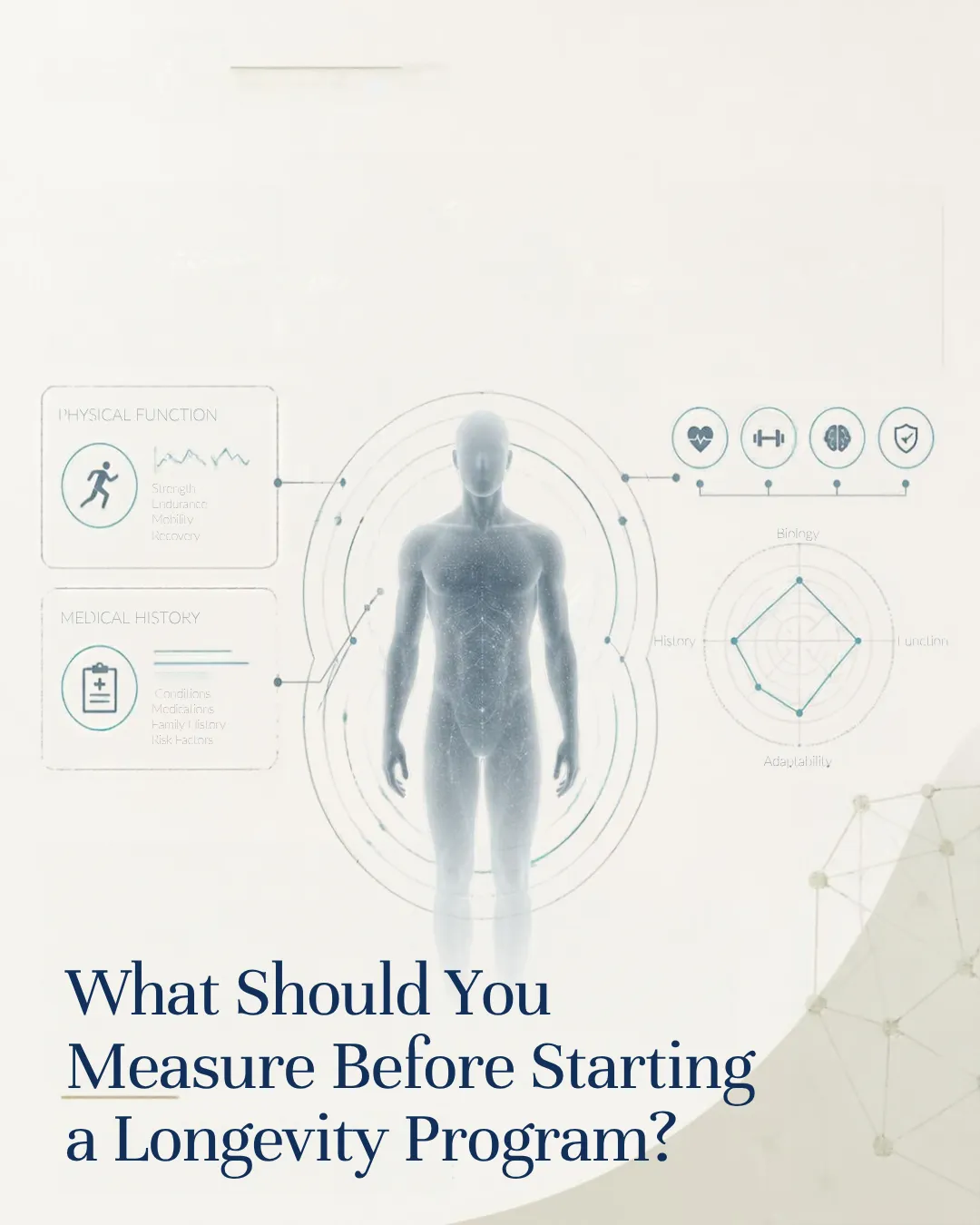
What Should You Measure Before Starting a Longevity Program?
Inside the Institute for Human Optimization’s approach to understanding your health, function, and capacity to adapt
Before starting a longevity program, you should have a clear understanding of your health today.
That means understanding more than your weight, your total cholesterol, or whether your annual laboratory results fall within the reference range. It means examining your biology alongside your physical function, medical history, and ability to respond to challenge.
At the Institute for Human Optimization, we bring these elements together to answer a practical question: What deserves attention now to help protect your health and function over time?
Measuring Hundreds of Biomarkers With a Purpose
Our comprehensive assessments can incorporate hundreds of biomarkers, with the selection guided by the patient’s history, clinical needs, and scope of evaluation.
Depending on the assessment, we may examine cardiovascular risk, blood sugar regulation, kidney and liver function, hormonal health, nutrient status, inflammation, and other biological processes. More advanced evaluations may incorporate genomic and multiomic information to explore additional aspects of an individual’s biology.
But the number of measurements is only the beginning.
Many patients have never heard of some of these biomarkers. Even within health care, certain specialized tests fall outside routine practice. Knowing which tests are appropriate and how to interpret their results requires familiarity with their evidence, limitations, and clinical applications.
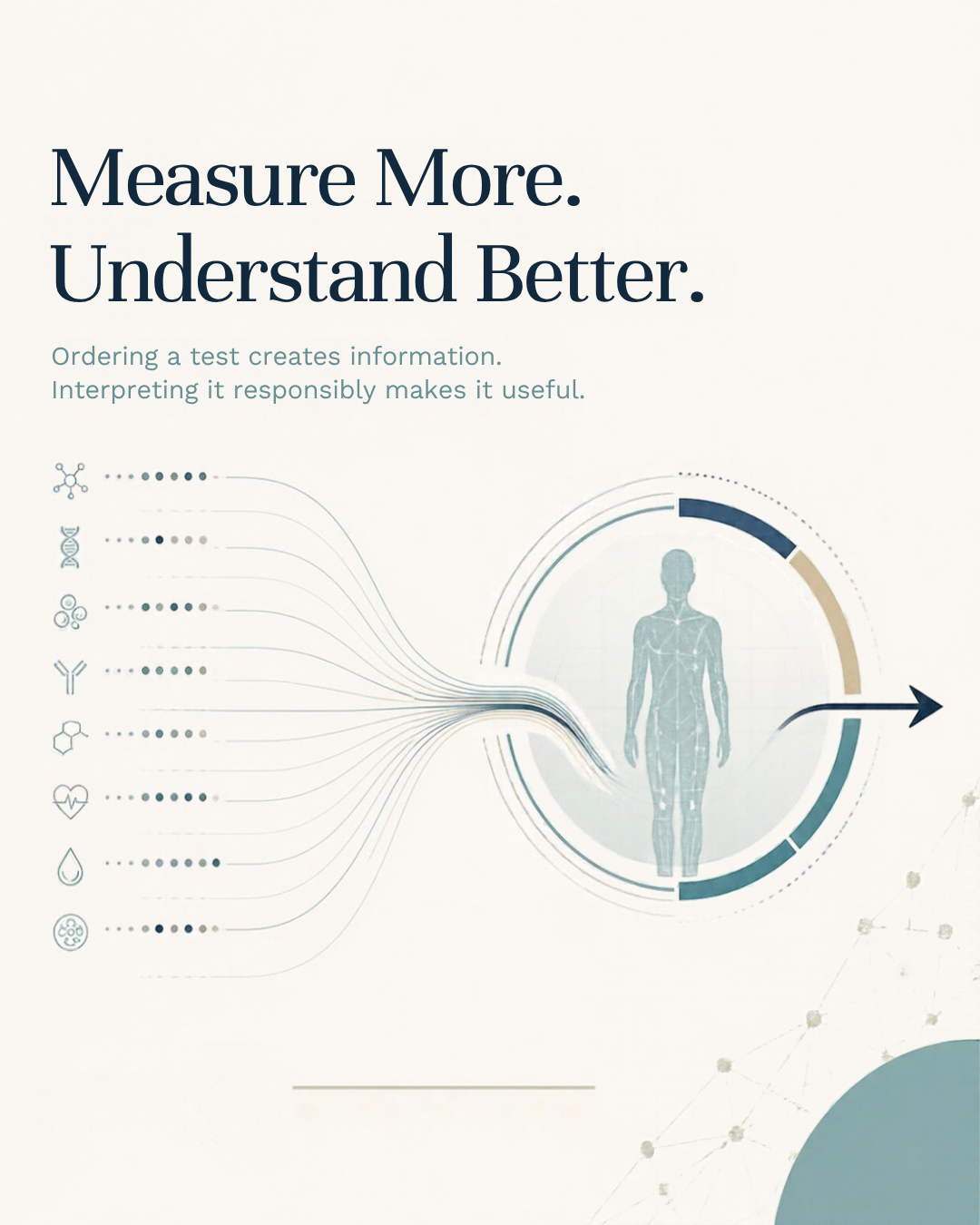
Ordering a test creates information. Interpreting it responsibly determines whether that information is useful.
Interpretation Requires More Than Reading the Flagged Results
A result marked “normal” does not answer every clinical question. An abnormal result does not automatically require treatment.
We consider each finding in context:
What does this marker reliably tell us?
How does it relate to the patient’s symptoms, history, and other results?
Could medications, recent exercise, illness, or testing conditions influence it?
Does it warrant confirmation or further evaluation?
Would acting on it meaningfully change care?
Some biomarkers have established roles in diagnosis and prevention. Others provide emerging information whose clinical usefulness is still being studied. That distinction matters.
At the Institute, the purpose of an extensive assessment is to identify meaningful patterns, prioritize findings, and explain what they may—or may not—mean for your care.
VO₂ Max: Measuring Aerobic Capacity
Bloodwork cannot tell us everything about how your body performs.
We incorporate VO₂ max testing, when appropriate, to assess aerobic capacity: how effectively your body takes in, transports, and uses oxygen during exercise.
Cardiorespiratory fitness provides information associated with cardiovascular health and long-term outcomes. The American Heart Association has highlighted its value as a clinical vital sign. (pubmed.ncbi.nlm.nih.gov)
For the patient, the value is practical. Testing can establish a starting point, inform an exercise prescription, and provide a measurement to follow as training progresses.
We interpret the result alongside your age, medical history, symptoms, and current activity level.
Grip Strength, Body Composition, and Functional Performance
We also assess physical capabilities that a laboratory panel cannot capture.
Grip strength contributes one measure of muscular function. Body composition adds information about fat and lean tissue beyond what the scale shows. Functional assessments help us understand how strength, balance, mobility, and endurance translate into movement.
Depending on the patient, this may include evaluating:
Grip strength.
Balance and stability.
Mobility and movement limitations.
The ability to rise from a chair.
Walking or other relevant physical tasks.
Performance and recovery during appropriate exercise assessments.
These measurements help connect the evaluation to everyday goals: carrying your children, climbing stairs comfortably, maintaining independence, or continuing the activities you enjoy.
Adaptive Capacity: How Do You Respond to Challenge?
We use adaptive capacity as a framework for examining how your body responds to physical demands and recovers afterward.
Resting measurements provide valuable information. We also want to understand what happens when your body has to do more.
How well can you sustain an appropriate workload? How does your heart rate respond? How quickly do you recover? Are there limitations that deserve further investigation?
We consider these observations alongside sleep, symptoms, training history, and other clinical findings. Adaptive capacity is a broader clinical framework, rather than a single universally validated score.
This helps us build a more complete picture of your current capabilities and identify appropriate opportunities for improvement.
Bringing Biology and Function Together
The most useful findings often emerge when we examine these areas together.
A patient may have reassuring routine laboratory results but limited aerobic fitness. Someone losing weight may also need closer attention to muscle preservation and strength. An active person may have an inherited cardiovascular risk factor that warrants a separate prevention discussion.
Each situation calls for a different response.
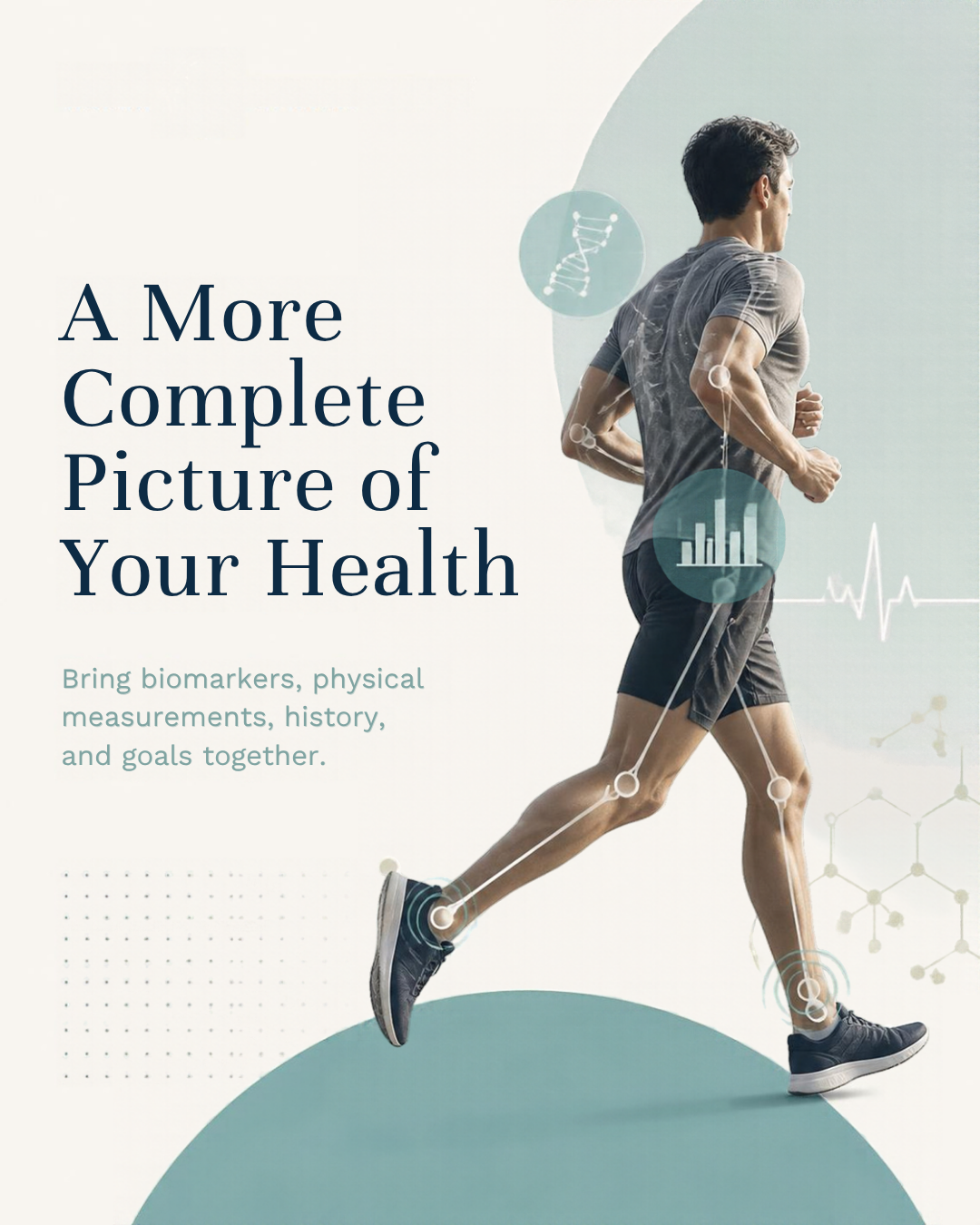
Our assessment brings together biomarkers, physical measurements, medical history, and patient goals so that recommendations reflect the whole clinical picture.
From Measurements to a Plan
A comprehensive evaluation should leave you with a clearer understanding of:
Which findings matter most.
What requires treatment or further evaluation.
Where nutrition, exercise, sleep, or other changes may help.
Which advanced interventions, if any, are appropriate.
What we will reassess and when.
At the Institute for Human Optimization in Hanover, Maryland, Dr. Anil Bajnath uses this approach to guide care around your biology, current function, and long-term goals.
Start with a deeper understanding of your health. Schedule a consultation to explore an assessment at the Institute for Human Optimization.
Medical disclaimer: This article is intended for educational purposes and does not constitute individualized medical advice. Therapeutic plasma exchange has established medical indications, but its use for general anti-aging or longevity purposes remains investigational. Molecular and animal research findings do not establish clinical benefit in humans. TPE carries potential risks and requires appropriate medical evaluation.