
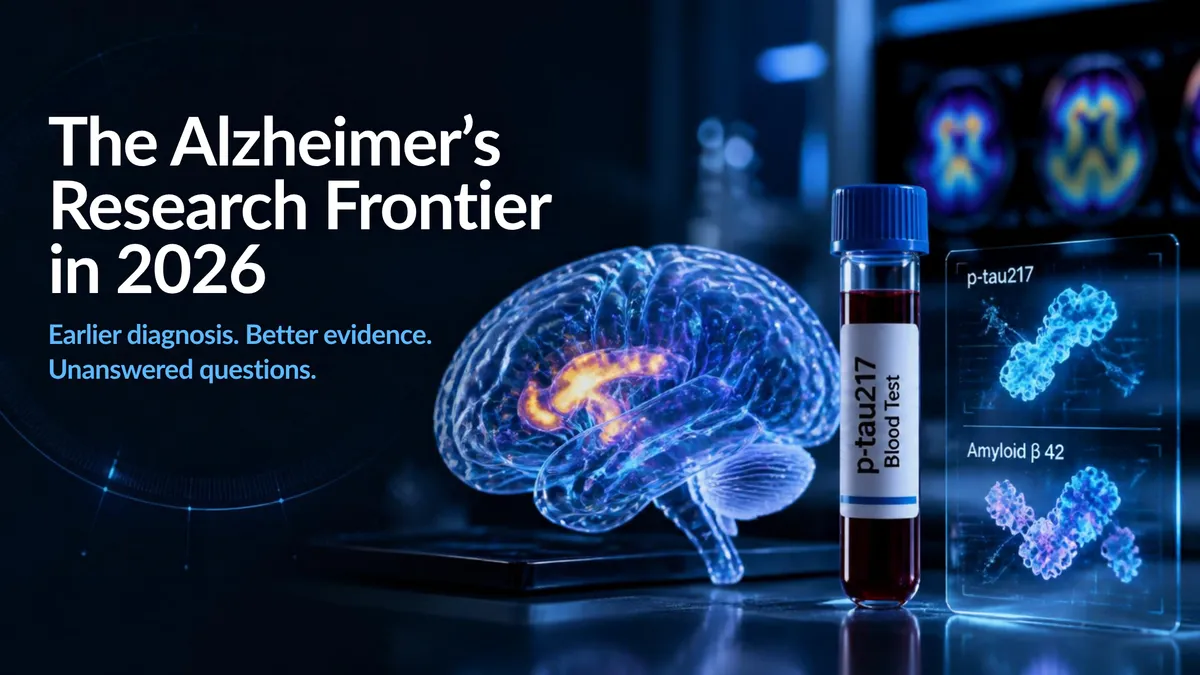
The Alzheimer’s Research Frontier in 2026: From Earlier Diagnosis to the Next Generation of Treatments
An evidence-forward look at what is available, what is being tested, and where the science still falls short.
For decades, Alzheimer’s disease research was defined by a difficult imbalance: the biology was becoming more detailed, but treatment options remained limited. That is beginning to change. Researchers can now identify Alzheimer’s-related pathology more precisely, and two disease-modifying medicines have shown that slowing clinical decline is possible for some people with early symptomatic disease.
The progress is real. So are its limits. Current treatments are not cures, many patients are not eligible, and promising theories continue to fail when tested in rigorous trials. The most interesting question in 2026 is no longer simply whether a drug can remove amyloid from the brain. It is whether the field can intervene earlier, target additional disease mechanisms, reduce treatment risks, and preserve function that matters to patients.
Here are the developments we are watching at the Institute for Human Optimization.
Anti-amyloid treatment has entered clinical practice and is still evolving
Lecanemab and donanemab have demonstrated modest slowing of clinical decline in selected patients with early symptomatic Alzheimer’s disease and confirmed amyloid pathology. They do not restore lost abilities or stop disease progression. Treatment also requires careful evaluation and monitoring because amyloid-related imaging abnormalities, known as ARIA, can include brain swelling or bleeding.
Biotechnology companies are now trying to improve how these treatments are delivered. In July 2026, a subcutaneous initiation option for lecanemab received U.S. approval. A less burdensome method of administration may improve access for some patients, but it does not remove the need to assess risks or monitor treatment.
Regulatory decisions outside the United States also show how carefully the benefit-risk balance is being weighed. The European Union has authorized both Leqembi and Kisunla, but their EU authorizations are restricted to patients with zero or one APOE ε4 copy. This differs from the U.S. approach and reflects concern about higher ARIA risk among people with two ε4 copies. Availability and reimbursement can differ further by country.
Can treatment begin before symptoms?
Most disease-modifying trials to date have focused on people already experiencing mild cognitive impairment or mild dementia due to Alzheimer’s. Yet amyloid and other biological changes can precede symptoms by years.
This has led to a major change in trial design. The AHEAD 3-45 study is evaluating lecanemab in people with elevated amyloid who do not yet have symptoms. TRAILBLAZER-ALZ 3 is studying donanemab in preclinical Alzheimer’s disease. Roche has also launched a phase 3 prevention study of trontinemab in cognitively unimpaired people at risk of progression.
These studies are important because they test a different proposition: Could treating Alzheimer’s biology before symptoms appear delay the onset of clinical disease? As of September 2026, that question remains unanswered. A positive amyloid test in someone without symptoms does not, by itself, establish that treatment will help them.
Drug developers are working on the blood–brain barrier
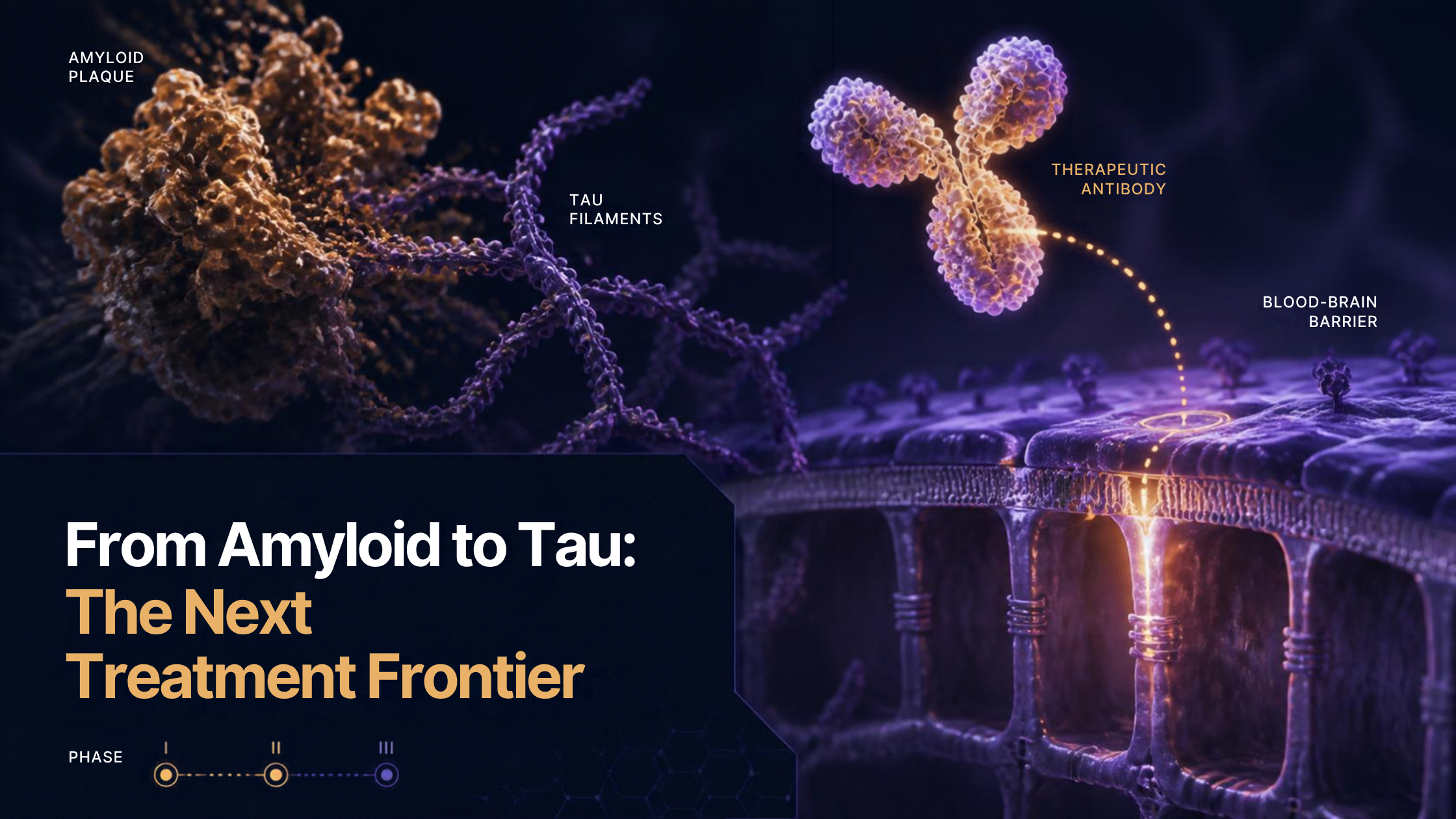
A recurring challenge in neurology is delivering enough medicine to the brain. Large antibody molecules have limited passage across the blood–brain barrier.
Roche’s trontinemab uses a “brain shuttle” design intended to improve brain delivery of an amyloid-targeting antibody. It is being studied in phase 3 trials involving people with early symptomatic Alzheimer’s, as well as in the prevention study.
The engineering is scientifically interesting. But more efficient delivery or faster amyloid removal will not be sufficient on its own to establish a better treatment. Trials still need to show whether patients experience meaningful differences in cognition and daily function and at what safety cost.
Tau is moving toward the center of drug discovery
Amyloid has dominated the treatment conversation, but tau is another central feature of Alzheimer’s pathology. Abnormal tau accumulation is closely associated with neurodegeneration, making it an important therapeutic target.
One of the most closely watched candidates is diranersen, also known as BIIB080, an antisense medicine designed to reduce production of tau protein. Data presented from its phase 2 CELIA study in 2026 included encouraging signals involving tau measures and clinical outcomes. The overall interpretation remains mixed, however, including questions about the primary dose-response analysis. Larger confirmatory trials are needed before anyone can conclude that reducing tau with this approach slows Alzheimer’s in clinical practice.
Other companies are investigating tau-directed antibodies, vaccines, and different ways of interfering with tau accumulation or spread. These strategies remain investigational. The opportunity is substantial, but no tau-directed treatment has yet become an established Alzheimer’s therapy.
Blood tests could change who gets evaluated and how quickly
Advances in diagnosis may prove almost as consequential as advances in treatment. In 2025, the FDA cleared a blood test measuring a ratio involving p-tau217 and amyloid-beta to aid the evaluation of symptomatic adults in specialized care. Additional Alzheimer’s blood tests received regulatory attention in 2026.
These tools may help clinicians identify who needs further evaluation, reduce reliance on more invasive testing for some patients, and make clinical-trial enrollment more efficient. They also require restraint. A blood test is not a stand-alone diagnosis, a forecast of exactly when symptoms will occur, or a reason to treat an otherwise healthy person without a comprehensive assessment.
The immune system is a target but an attractive mechanism is not enough
The brain’s immune cells, called microglia, participate in responses to injury and Alzheimer’s pathology. Genetic discoveries involving immune-related pathways have encouraged biotech companies to develop treatments aimed at changing microglial activity.
The TREM2 pathway has attracted particular attention. Yet the phase 2 AL002 program did not establish the hoped-for clinical benefit. That result does not mean neuroimmune biology is irrelevant. It does show that activating a biologically plausible target does not necessarily improve a patient’s outcome. Researchers still need to determine whether a different agent, disease stage, or patient group could make the approach effective.
Metabolic research received a valuable and disappointing answer
The connection between metabolism and Alzheimer’s remains scientifically important. Insulin signaling, vascular health, inflammation, and cellular energy regulation are all being studied as contributors to cognitive decline. This is part of the reason some researchers have used the phrase “type 3 diabetes” to examine Alzheimer’s through a metabolic lens.
But a strong rationale must survive a clinical trial. In two large international phase 3 studies, evoke and evoke+, oral semaglutide did not slow clinical progression in people with early Alzheimer’s disease. The trials randomized approximately 3,800 participants, making their published negative findings an important development.
The result does not prove metabolism has no role in Alzheimer’s. It does mean that this particular drug, dose, population, and treatment strategy did not produce the anticipated clinical benefit. That is how scientific understanding advances: compelling hypotheses must be tested, and negative results must count.
What about plasma exchange?
Therapeutic plasma exchange, or TPE, remains an area of investigation rather than an established Alzheimer’s treatment. The AMBAR study tested a prolonged plasma-exchange regimen with albumin replacement in people with mild-to-moderate Alzheimer’s disease. It reported less decline in activities of daily living in the combined treatment groups. Its overall co-primary cognitive outcome favored treatment but did not meet the conventional threshold for statistical significance.
AMBAR provides a reason to continue research. Any clinical consideration of TPE requires an individualized physician-led discussion, not an assumption that an intriguing study makes a patient suitable.
What comes next?
Several other frontiers warrant attention: treatments aimed at APOE biology, strategies addressing vascular and blood brain barrier dysfunction, combinations targeting more than one pathway, and approaches using focused ultrasound or novel delivery systems. Gene and cell-based strategies are also being investigated, though much of that work remains early-stage or preclinical.
Artificial intelligence may accelerate target discovery, molecule design, and the analysis of imaging and biomarker data. It can help researchers decide what to test. It cannot replace the clinical trials required to show that a treatment helps people live or function better.
The Institute for Human Optimization participates in clinical research related to Alzheimer’s disease because progress depends on precisely that kind of testing. Research participation is separate from clinical care, with its own eligibility requirements, oversight, and informed-consent process.
The outlook is more promising than it was a decade ago, but the frontier is not the same as the standard of care. We have treatments that modestly slow decline for some patients, better diagnostic tools, and prevention trials that could reshape the field. We also have failures reminding us that changing a biomarker is not the same as preserving memory or independence.
For patients and families, the best first step remains an individualized evaluation that establishes what is happening now, what is treatable today, and which research questions may be relevant. To learn more about the Institute’s approach to brain health or inquire about research opportunities, contact our team. An inquiry does not establish clinical-trial eligibility or suitability for any treatment.
This article reflects research and regulatory information available as of September 12, 2026. It is educational and does not replace individualized medical advice. Investigational therapies are not established treatments, and clinical-trial participation requires separate evaluation and informed consent.