
Your Mammogram May Reveal More Than Breast Cancer: What Women Should Know About Heart Health
Maryland’s new breast arterial calcification notification law brings attention to an often-overlooked cardiovascular risk marker. Here is what the science tells us, what remains uncertain, and why it matters for women’s long-term health.
A Mammogram Was Never Intended to Be a Heart Test. But It May Tell Us Something About the Heart.
For decades, mammography has played an important role in the early detection of breast cancer. Millions of women undergo routine screening with the understanding that the images are being evaluated for abnormalities in breast tissue.
But those same images can reveal something else: calcium deposits within the arteries of the breast.
This finding is called breast arterial calcification (BAC).
Historically, BAC was often considered an incidental imaging finding, something visible to the radiologist but not necessarily included in the information communicated to the patient.
That is beginning to change.
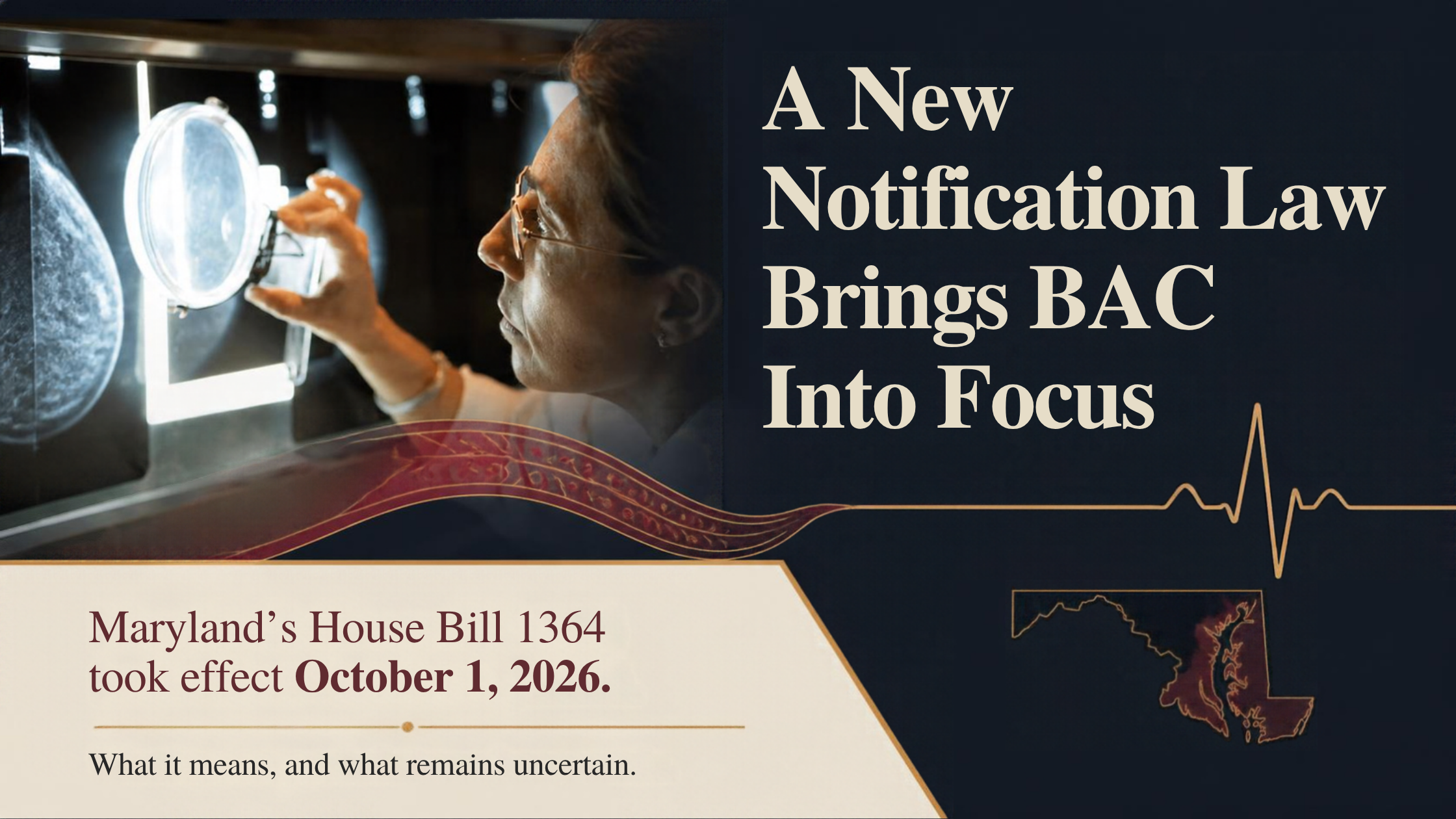
On October 1, 2026, Maryland’s House Bill 1364 took effect, requiring mammography centers to notify patients when breast arterial calcification is identified on their mammograms.
The significance extends beyond Maryland.
We are beginning to recognize that information collected during one type of preventive screening may offer insight into another dimension of health.
And when it comes to cardiovascular disease in women, that matters.
First, What Exactly Is Breast Arterial Calcification?
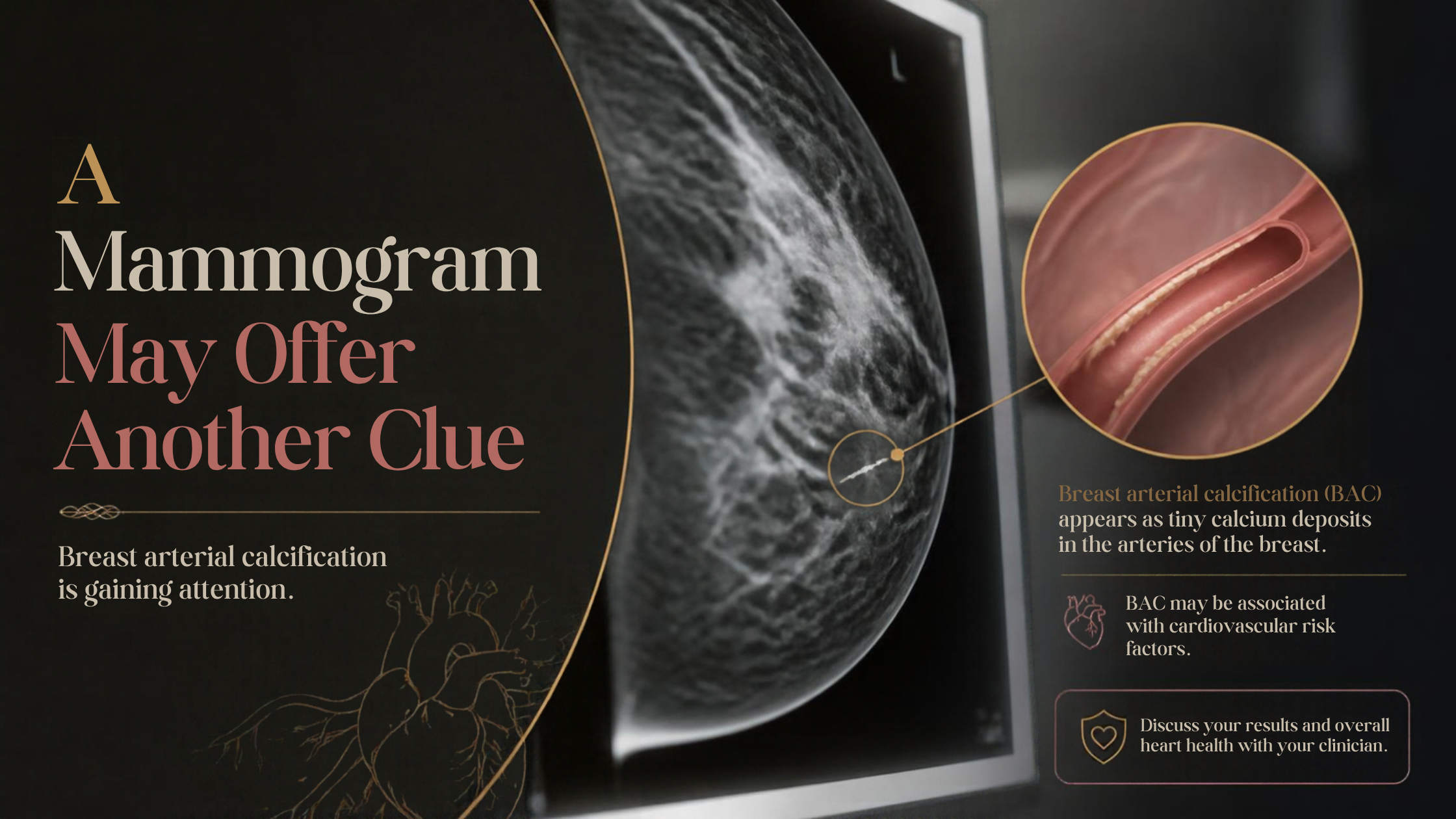
Breast arterial calcification occurs when calcium accumulates within the walls of arteries supplying blood to breast tissue.
On a mammogram, these deposits may appear as thin, parallel, or tram-track-like white lines following the course of a blood vessel.
Importantly, BAC is not the same as the breast calcifications that radiologists evaluate for possible malignancy.
BAC is not breast cancer, nor does its presence mean a woman has breast cancer.
It is also important to distinguish BAC from coronary artery calcification.
Coronary artery calcium, commonly measured through a dedicated cardiac CT scan, generally reflects calcified atherosclerotic plaque within the arteries supplying the heart.
Breast arterial calcification, by contrast, typically involves calcium deposition within the medial layer of the arterial wall, a process associated with vascular stiffness.
These are different biological processes, although they may share underlying cardiovascular risk factors.
The presence of BAC does not establish that coronary arteries are blocked, nor does it automatically indicate coronary artery disease.
What it may indicate is an opportunity to look more closely at cardiovascular risk.
What Does the Research Actually Show?
The relationship between breast arterial calcification and cardiovascular disease has been studied for years, but more recent research has strengthened the evidence of an association.
A large study published in Circulation: Cardiovascular Imaging, highlighted by the American Heart Association in 2022, followed women without known cardiovascular disease or breast cancer for approximately 6.5 years.
Researchers reported that women with BAC had:
* 51% higher relative risk of developing coronary heart disease or experiencing a stroke.
* 23% higher relative risk of developing a broader cardiovascular outcome, including heart failure and peripheral arterial disease.
These findings were observational. They do not establish that BAC causes cardiovascular disease.
A separate study discussed by the American Heart Association in 2023 examined 1,216 women between the ages of 40 and 75.
Approximately one in five had detectable BAC.
Over ten years, a major cardiovascular event occurred in approximately 21% of women with BAC, compared with 11% of women without it.
More recently, a 2026 meta-analysis pooling approximately 25,000 women across four cohort studies found an association between BAC and future cardiovascular events, with a pooled hazard ratio of 1.82.
That corresponds to an approximately 82% higher relative event hazard in the populations studied.
These are meaningful findings, but they require interpretation.
An increase in relative risk is not the same as an individual’s absolute probability of experiencing a cardiovascular event.
A woman’s age, metabolic health, blood pressure, cholesterol, diabetes status, family history, and other factors all influence her underlying risk.
We also do not yet know whether treating women differently based specifically on BAC findings improves cardiovascular outcomes.
The evidence supports BAC as a potentially useful cardiovascular risk marker. It does not yet establish BAC as a standalone diagnostic test or a reason for automatic intervention.
That distinction is central to responsible preventive medicine.
Why This Matters So Much for Women
Cardiovascular disease remains the leading cause of death among women in the United States.
Yet public awareness, preventive screening, and conversations about women’s health have historically emphasized other conditions, particularly breast cancer.
Breast cancer screening is essential. But cardiovascular prevention deserves comparable attention.
Consider the statistics.
According to the American Heart Association’s 2025 statistical update:
Approximately 44.8% of U.S. women age 20 and older had some form of cardiovascular disease, including hypertension, during the 2017–2020 measurement period.
Cardiovascular disease accounted for 446,912 deaths among women in 2022.
Approximately 59% of non-Hispanic Black women had cardiovascular disease, compared with 44.6% of non-Hispanic White women, 37.3% of Hispanic women, and 38.5% of non-Hispanic Asian women.
These figures reflect differences in risk factors, access to care, social conditions, and other determinants of cardiovascular health. They should not be interpreted as evidence that race itself determines biological destiny.
The long-term outlook is equally concerning.
In February 2026, the American Heart Association published projections suggesting that, by 2050:
More than 59% of U.S. women may have hypertension.
More than 25% may have diabetes.
More than 61% may have obesity.
The prevalence of cardiovascular disease and stroke, excluding hypertension alone, may rise from approximately 10.7% to 14.4%.
These are projections, not inevitable outcomes.
But they illustrate why cardiovascular prevention cannot begin only after a heart attack, stroke, or other clinical event.
It needs to begin earlier.
Women’s Cardiovascular Risk Is Not Simply a Smaller Version of Men’s
Women experience many of the same cardiovascular risk factors as men, including hypertension, elevated LDL cholesterol, diabetes, smoking, and physical inactivity.
However, several important aspects of cardiovascular risk are particularly relevant to women.
Pregnancy can reveal future cardiovascular vulnerability.
A history of preeclampsia, gestational hypertension, or gestational diabetes may identify women at increased long-term cardiovascular risk.
These complications should not be treated as isolated events that become irrelevant after delivery.
They can provide valuable information about future cardiometabolic health.
Menopause changes the cardiovascular landscape.
The menopausal transition is associated with changes in body fat distribution, lipid metabolism, vascular function, and cardiometabolic risk.
Although estrogen has important vascular effects, menopause is not a diagnosis of cardiovascular disease, and hormone therapy should not be prescribed solely to prevent cardiovascular events.
The appropriate approach is individualized risk assessment.
Cardiovascular disease may present differently.
Chest discomfort remains an important symptom of heart attack in both women and men.
Women may also experience shortness of breath, nausea, unusual fatigue, or discomfort in the back, jaw, or upper abdomen.
Symptoms should never be dismissed simply because they do not match the stereotypical image of a heart attack.
Women may also experience forms of ischemic heart disease involving coronary microvascular dysfunction or vasospasm, even without major obstructive coronary lesions.
This is one reason a thoughtful cardiovascular evaluation matters.
A Positive BAC Finding: What Should Happen Next?
A woman who receives a mammogram report identifying BAC should not assume she has heart disease.
She should also not ignore the finding.
The appropriate next step is a conversation with her physician about her overall cardiovascular risk.
That evaluation may include:
Blood pressure. Hypertension is one of the most important modifiable cardiovascular risk factors, and it often develops without obvious symptoms.
Lipid assessment. LDL cholesterol and non-HDL cholesterol remain important. In selected patients, apolipoprotein B and lipoprotein(a) may help clarify risk.
Metabolic health. Glucose regulation, diabetes status, body composition, and other cardiometabolic factors can influence cardiovascular outcomes.
Family history. Premature cardiovascular disease in close relatives may change how aggressively risk should be assessed and managed.
Reproductive history. Pregnancy complications and premature menopause can provide additional context.
Lifestyle and functional health. Physical activity, cardiorespiratory fitness, nutrition, smoking exposure, and sleep all contribute to long-term cardiovascular health.
Clinicians may also use validated cardiovascular risk prediction tools, including the American Heart Association’s PREVENT equations, to estimate risk and support shared decision-making.
In selected individuals, coronary artery calcium scoring or other testing may be appropriate based on established indications.
But BAC alone does not mean every woman needs a cardiac CT scan, stress test, or prescription medication.
Testing should answer a meaningful clinical question and ideally change management.
More information is not automatically better care.
The Precision Medicine Perspective: A Finding Is Not a Diagnosis
At the Institute for Human Optimization, we approach preventive and longevity medicine through an evidence-forward lens.
That means taking emerging research seriously without presenting every association as an established clinical intervention.
Breast arterial calcification is an excellent example.
A finding may be statistically associated with disease without being sufficiently specific to diagnose that disease.
A marker may predict risk without being the direct cause of that risk.
And a new technology may identify abnormalities more efficiently without yet demonstrating that its use improves patient outcomes.
These distinctions matter.
Consider two women with BAC identified on their mammograms.
One may be 75 years old with hypertension, diabetes, elevated LDL cholesterol, and a history of smoking.
Another may be 48 years old with normal blood pressure, favorable lipid measurements, no diabetes, and no family history of premature cardiovascular disease.
The same imaging finding does not necessarily carry the same clinical implications for both women.
Their absolute risks, competing risks, and appropriate preventive strategies may be very different.
That is the value of precision medicine when practiced responsibly: not simply collecting more biomarkers, but understanding which findings meaningfully change decisions for an individual patient.
We should also remember that the absence of BAC does not establish low cardiovascular risk.
A normal BAC assessment cannot replace a comprehensive cardiovascular evaluation.
The Bigger Opportunity: Connecting the Information We Already Have
Healthcare often evaluates the human body through separate specialties and systems.
A mammogram evaluates the breast.
A lipid panel evaluates circulating cholesterol.
A glucose measurement evaluates one dimension of metabolic health.
A blood pressure reading evaluates another.
Each has value, but none tells the complete story.
The opportunity is to integrate these findings.
Could an imaging observation prompt a conversation that otherwise would not have occurred?
Could that conversation identify untreated hypertension, elevated lipoprotein(a), diabetes, or a significant family history?
Could appropriate treatment of established risk factors reduce the likelihood of a future cardiovascular event?
Those are the questions worth asking.
And they are more important than simply identifying another abnormality.
The goal is not to medicalize every incidental finding.
The goal is to recognize clinically meaningful information early enough to act when action is warranted.
What We Still Do Not Know
An evidence-forward discussion should also acknowledge the limitations.
Despite promising research, several questions remain unresolved.
We do not yet have universally standardized BAC grading and reporting methods across mammography practices.
We do not fully understand how much BAC improves cardiovascular risk prediction beyond established clinical risk factors across different ages and populations.
We do not know whether BAC-directed screening or treatment pathways reduce heart attacks, strokes, or cardiovascular mortality.
And although artificial intelligence may improve the detection and quantification of BAC, better detection does not automatically establish better clinical outcomes.
Prospective studies are needed to determine how best to incorporate BAC into routine cardiovascular prevention.
Recognizing these limitations does not diminish the value of the research.
It is how we distinguish scientific promise from proven clinical benefit.
Why We Care at the Institute for Human Optimization
Our interest in cardiovascular health extends beyond the diagnosis and treatment of established disease.
Cardiovascular health influences how we age, how we function, and how long we remain capable of living independently.
Blood pressure, metabolic health, physical fitness, lipid biology, and vascular function all contribute to that picture.
At IFHO, we believe preventive care should be proactive, individualized, and grounded in an honest interpretation of the available evidence.
That includes recognizing when established preventive measures are appropriate, when additional evaluation may be useful, and when an emerging biomarker does not yet justify intervention.
For women especially, cardiovascular health deserves attention across the lifespan, not simply after menopause or following the onset of symptoms.
Maryland’s new BAC notification requirement creates an opportunity to start those conversations.
But the legislation itself is only the beginning.
Its long-term value will depend on whether the information improves risk recognition, appropriate preventive care, and ultimately patient outcomes.
A Final Thought
A mammogram showing breast arterial calcification is not a cardiovascular diagnosis.
It is not a prediction that a woman will have a heart attack.
And it is not a reason to panic.
But it may be a reason to ask better questions.
What is this patient’s underlying cardiovascular risk?
Are there modifiable risk factors that have gone unrecognized?
Would additional evaluation change management?
And are we making the best use of the information already available to us?
We should be cautious about turning every association into an intervention.
We should be equally cautious about dismissing meaningful information simply because it was discovered incidentally.
Prevention begins with recognizing what we might otherwise overlook.
And for women’s cardiovascular health, that recognition may be especially important.