
Multiple Sclerosis and the Microbiome: What Emerging Research Is Teaching Us About Precision Medicine
For decades, multiple sclerosis has been understood primarily as an immune-mediated disease of the central nervous system. We know that immune cells participate in the destruction of myelin, the protective covering surrounding nerve fibers, resulting in neuroinflammation, demyelination, and eventually neuroaxonal injury.
What has remained much more difficult to answer is why.
Why does one person develop multiple sclerosis while another person with similar genetic susceptibility does not?
Why can the disease remain relatively stable in one patient while progressing more aggressively in another?
And what initiates or perpetuates the immune response in the first place?
Increasingly, researchers are looking beyond the central nervous system for part of the answer.
One area receiving considerable attention is the gut microbiome.
Recent research is adding greater resolution to a relationship scientists have been investigating for years. Rather than simply observing that the intestinal microbiome of people with multiple sclerosis differs from that of people without the disease, researchers are beginning to identify specific microorganisms, microbial functions, metabolites, and interactions with human genetics that may be biologically relevant to MS.
This is where the story becomes particularly important for precision medicine.
Multiple Sclerosis Is Not the Product of a Single Variable
Multiple sclerosis is a complex disease.
There is no single MS gene. There is no single environmental exposure that explains every case. And despite increasingly interesting microbiome research, there is currently no evidence that one bacterial species alone can explain the development of MS.
Instead, our current understanding points toward an interaction among genetic susceptibility, immune regulation, environmental exposures, and other biological influences.
The microbiome may be one component of that network.
The human gastrointestinal tract contains an extraordinarily complex ecosystem of microorganisms. These organisms participate in metabolism, produce bioactive compounds, interact with the intestinal barrier, and communicate extensively with the immune system.
That last point is particularly relevant to autoimmune disease.
A substantial portion of immune activity occurs at mucosal surfaces. The immune system must continuously distinguish between organisms and antigens that can be tolerated and those that require a response.
When that relationship changes, the effects may extend well beyond the gastrointestinal tract.
This is one of the reasons the gut has become an important area of investigation in neuroimmunology.
What Are Researchers Finding?
The association between MS and the microbiome is not entirely new.
Previous studies have demonstrated differences in the gut microbial communities of individuals with MS compared with healthy controls. What is changing is the scale and sophistication of the research.
A 2026 study published in npj Biofilms and Microbiomes analyzed metagenomic data from more than 1,300 individuals across three geographically diverse cohorts. Researchers identified alterations involving 90 bacterial species, three fungal species, two viral species, 119 functional genes, and 17 metabolic pathways associated with MS.
That finding deserves careful interpretation.
It does not mean researchers discovered 90 bacteria that cause multiple sclerosis.
It demonstrates something much more nuanced.
The microbial ecosystem associated with MS appears to differ at multiple biological levels, including not only which organisms are present, but also the functional and metabolic characteristics of that ecosystem.
The investigators then used these microbial features to develop machine learning models designed to distinguish people with MS from healthy controls. Performance declined when the models were tested in external datasets, an important reminder of why independent validation matters, but the results suggest that microbial signatures may eventually have value as noninvasive biomarkers.
That is an important distinction.
Association is not causation. A potential biomarker is not yet a diagnostic test. And an interesting biological signal is not automatically a clinical intervention.
But these signals give us somewhere to look.
The Relationship May Work in Both Directions
One of the challenges in microbiome science is determining directionality.
If researchers identify a particular microbial pattern in people with MS, did the microbial change contribute to the disease?
Did MS alter the intestinal environment and therefore change the microbiome?
Did medication change it?
Did diet, geography, age, or another environmental variable influence both?
Or are several of these things occurring simultaneously?
These are not trivial questions.
Earlier research has established that people with MS can have distinct gut microbial profiles compared with healthy controls. However, researchers have appropriately cautioned that further investigation is necessary to determine whether those differences contribute to MS pathogenesis or occur as a consequence of the disease and its treatment.
This is precisely why microbiome science requires rigorous study.
Finding a difference is relatively easy.
Proving that the difference is biologically meaningful, reproducible, causal, and clinically actionable is much harder.
The Genetics and Microbiome Relationship Is Becoming Particularly Interesting
Another recent study provides an excellent example of why I believe the future of medicine will require integration across multiple biological systems.
Research published in Genes & Immunity in July 2026 investigated the relationship among human genetics, the gut microbiome, and MS.
The researchers identified an overlapping association involving theFcRL3 gene, MS, and the commensal bacterium Akkermansia massiliensis. The findings raise the possibility that a host genetic factor associated with immune regulation may also relate to microbial composition in a way that is relevant to MS susceptibility.
This is where the precision medicine framework becomes important.
The question is no longer simply:
Which bacteria are associated with MS?
We can ask a much more sophisticated question:
How does an individual's genetic architecture influence the microbial environment, and how might those interactions alter immune function and disease susceptibility?
That is a fundamentally different way of thinking about disease.
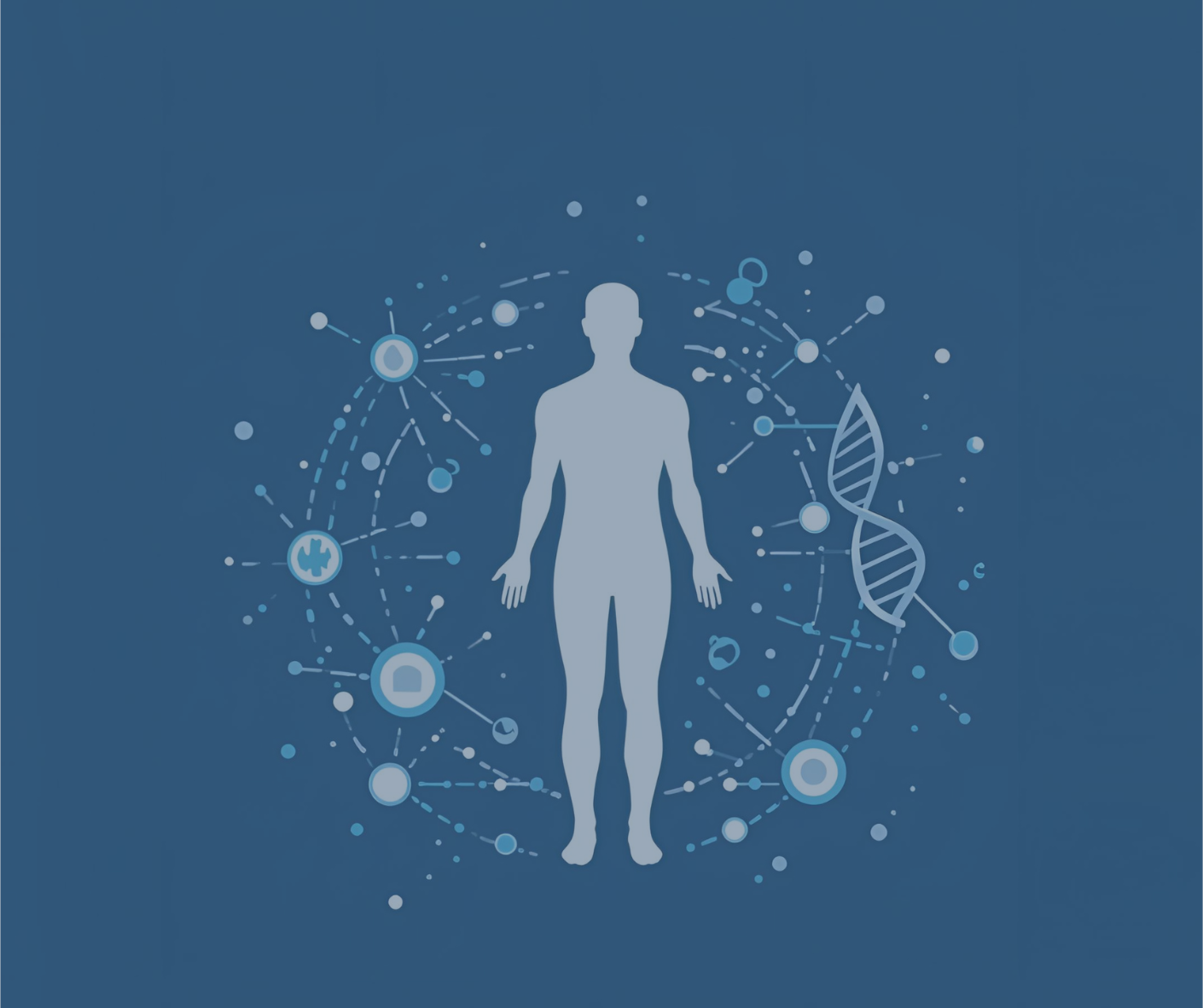
The genome and microbiome are not independent datasets sitting in separate laboratory reports.
They exist within the same biological system.
The Microbiome May Also Produce Biologically Active Signals
The microorganisms themselves are only part of the story.
What they produce may ultimately prove just as important.
Microbial metabolism generates compounds capable of interacting with intestinal cells, immune cells, and potentially distant tissues. This means that understanding the microbiome may require moving beyond taxonomy and asking what the microbial community is actually doing.
A study published in July 2026 investigated this concept using experimental autoimmune encephalomyelitis, commonly called EAE, a mouse model frequently used to study aspects of MS.
Researchers studied Veillonella ratti and found that administration of a particular strain reduced disease severity and demyelination in the experimental model. The intervention also altered the microbial environment and increased a microbial-associated metabolite that correlated with reductions in neuroinflammation and microglial activation.
This is preclinical research.
It should not be interpreted as evidence that administering this bacterium treats MS in humans.
But mechanistically, the study is interesting because it points toward a larger concept.
The relationship between the microbiome and the nervous system may not depend exclusively on the presence or absence of an organism.
Microbial metabolites may serve as biological messengers.
The Gut, Immune System, and Brain Are Not Separate Conversations
We frequently divide medicine into specialties because doing so is necessary for clinical practice.
Biology does not recognize those divisions.
The gastrointestinal tract communicates with the immune system.
The immune system communicates with the central nervous system.
Microbial metabolites enter circulation.
Genetic variation influences immune function.
Environmental exposures influence gene expression and microbial ecology.
Metabolism influences inflammatory signaling.
These systems are interconnected.
The gut-brain axis is therefore not simply an abstract wellness concept. It represents a network of neural, endocrine, metabolic, and immunologic communication that is increasingly being investigated in serious neurologic and immunologic research.
A major review in Nature Reviews Neurology previously concluded that accumulating evidence supports an important relationship between the gut microbiota, systemic immune responses, and neuroinflammatory diseases including MS. The authors also emphasized the need to determine how these observations can be translated into meaningful therapeutic strategies.
That translational step is critical.
This Is Where Precision Medicine Becomes Relevant
When people hear the term precision medicine, they often think about genetic testing.
Genomics is certainly an important component, but precision medicine is much broader.
The objective is to understand disease at greater biological resolution.
For a complex condition such as MS, that may eventually require integrating multiple layers of information.
Genomics can help characterize susceptibility.
Immunologic biomarkers can provide information about inflammatory activity.
The microbiome may reveal microbial patterns associated with immune regulation.
Metabolomics can help us understand the biochemical products generated by the host and its microbial ecosystem.
Environmental and lifestyle information can provide context for those molecular findings.
Imaging and clinical data tell us how the disease is actually manifesting in the patient.
Artificial intelligence may eventually help us identify relationships across these datasets that would be extremely difficult to recognize through conventional analysis alone.
Interestingly, the MS field itself is moving toward a more biologically informed framework. In August 2026, an international group of experts published a roadmap in Nature Reviews Neurology addressing the transition toward describing MS disease course using biological mechanisms in addition to conventional clinical classifications.
That shift is significant.
It reflects a larger transformation occurring throughout medicine.
We are moving from describing disease primarily according to what we observe toward understanding disease according to the biology producing what we observe.
What This Research Does Not Mean
Whenever emerging science receives public attention, it is equally important to discuss what the evidence does not establish.
Current microbiome research does not demonstrate that MS is simply a bacterial infection.
It does not establish that one microorganism causes MS.
It does not mean that commercial microbiome testing can currently determine whether an individual will develop MS.
It does not mean that probiotics, antibiotics, dietary supplements, or attempts to eliminate specific organisms should replace established MS treatment.
And it certainly does not justify discontinuing disease-modifying therapy in favor of an unvalidated microbiome intervention.
Those conclusions would extend far beyond the available evidence.
Precision medicine should not lower the standard of evidence required in medicine.
It should raise it.
The purpose of collecting more biological information is not to create more interventions.
It is to identify which information is reproducible, clinically meaningful, and capable of improving patient outcomes.
From Correlation to Clinical Utility
There is an enormous distance between discovering a biological association and changing medical practice.
For microbiome research in MS to become clinically actionable, we need to know whether microbial signatures can be reproduced across diverse populations.
We need longitudinal studies capable of determining whether changes occur before disease onset, after disease development, or in response to treatment.
We need to understand how diet, geography, medication, age, and other confounding variables affect microbial composition.
We need mechanistic studies demonstrating how specific organisms or metabolites alter immune function.
And ultimately, we need prospective clinical trials showing that using this information changes outcomes.
Until then, the microbiome should be viewed as a promising area of investigation rather than a completed clinical solution.
The Bigger Story Is Biological Individuality
The most interesting part of this research is not the discovery of a particular bacterium.
It is what these discoveries tell us about the complexity of human disease.
Two people may carry genetic susceptibility for the same condition and experience completely different outcomes.
Two people with the same diagnosis may have different immune profiles, metabolic environments, microbial ecosystems, environmental exposures, and disease trajectories.
The diagnostic label is important.
But the diagnostic label does not describe the entirety of the biology.
This is the central premise of precision medicine.
We should continue asking what disease a patient has.
But increasingly, we also have the scientific tools to ask a second question:
Why is this disease occurring and behaving this way in this particular patient?
The emerging relationship between the microbiome and multiple sclerosis is an excellent example of why that question matters.
We are not yet at the point where a stool sample can explain MS or dictate treatment.
But we are beginning to understand that the immune system, nervous system, genome, metabolism, and microbiome participate in a biological conversation far more complex than our traditional organ-based model of medicine suggests.
Understanding that conversation may ultimately allow us to classify disease more precisely, identify risk earlier, predict therapeutic response more accurately, and develop interventions based on mechanism rather than diagnosis alone.
That is the promise of precision medicine.
Not more testing.
Not more data for the sake of data.
References
Zhu G, Yang G. Multikingdom microbiome-based machine learning enables multiple sclerosis diagnosis.npj Biofilms and Microbiomes. 2026.
Orrú V, Marongiu M, Cocco E, et al. Potential role ofAkkermansia massiliensisin multiple sclerosis protection by the FcRL3 gene.Genes & Immunity. 2026.
Sittipo P, Park JY, Tiffany E, et al. Gut microbiome modulation byVeillonella rattiinduces resistance to EAE pathogenesis via microbe-derived metabolites.Experimental & Molecular Medicine. 2026.
Correale J, Hohlfeld R, Baranzini SE. The role of the gut microbiota in multiple sclerosis.Nature Reviews Neurology. 2022.
Thompson AJ, Lublin FD, Rechtman L, et al. Towards a biologically informed description of multiple sclerosis disease course: a roadmap for transition.Nature Reviews Neurology. 2026.
Anil Bajnath, MD, MBA, IFMCP, ABAARM, is a board-certified family physician whose work focuses on precision medicine, clinical genomics, systems biology, advanced biomarker analysis, and individualized approaches to health and disease. His academic and clinical interests include genomics, pharmacogenomics, nutrigenomics, metabolomics, microbiome science, longevity medicine, and the translation of complex biological information into clinically meaningful strategies.
Medical Disclaimer: This article is intended for educational and informational purposes only. It does not constitute medical advice, diagnosis, or treatment. The microbiome findings discussed are an emerging area of research and should not be interpreted as establishing a diagnostic or therapeutic approach to multiple sclerosis. Individuals should consult an appropriately qualified healthcare professional regarding personal medical concerns.
Custom HTML/CSS/JavaScript